Shenzhen Prototyping & AI Hardware Manufacturing
From napkin sketch to production-ready hardware — PCB/PCBA, tooling, EVT→DVT→PVT and OEM/ODM. A technical partner on the factory floor who catches DFM problems before they cost you a respin.
free 15-min consultation — 100% credited to any package you book within 30 days. No payment online; you confirm by reply.
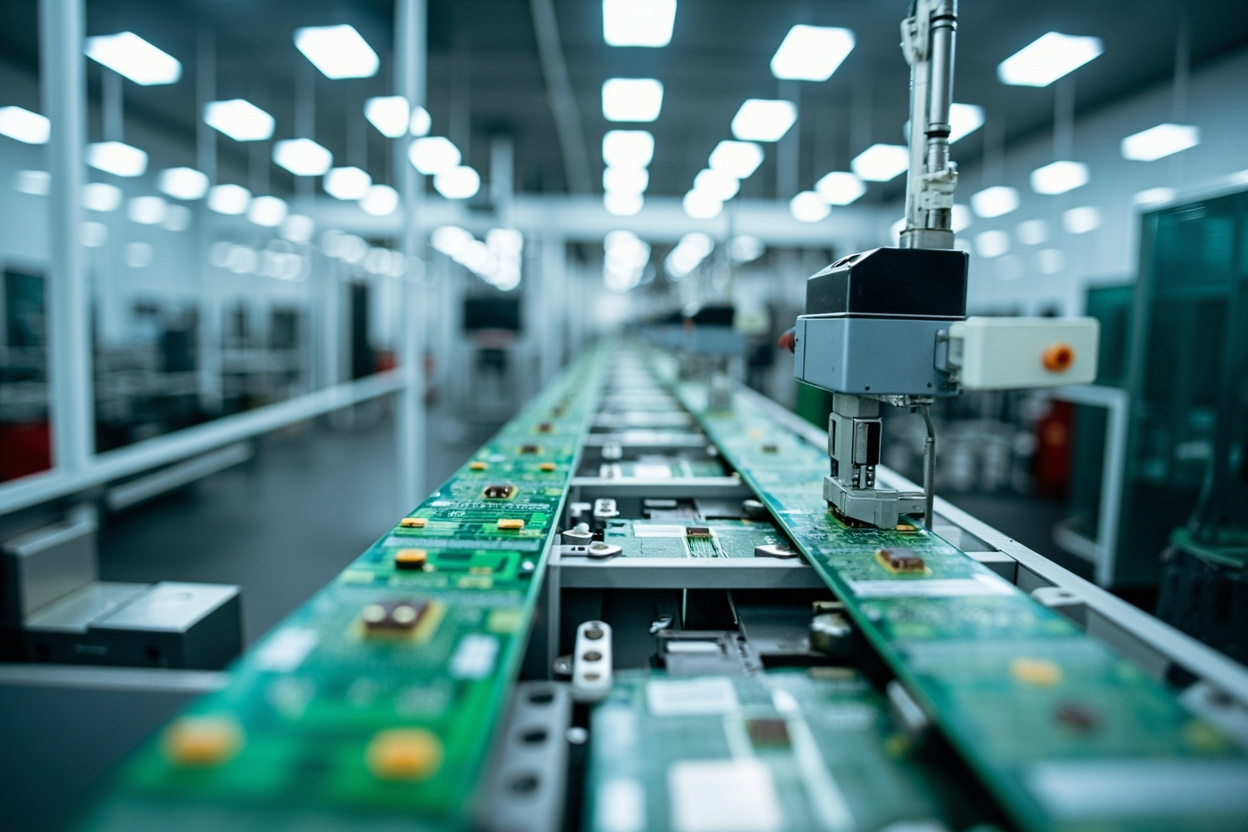
The Shenzhen / Greater Bay Area hardware ecosystem
Within a 10-kilometer radius, the GBA cluster integrates component distributors, PCB fabs, assembly houses, mold shops, design studios, test labs and logistics. Nowhere else can a PCB rev be ordered at 8 PM and arrive assembled the next night.
- Huaqiangbei (Futian) — the component & quick-turn nerve center. Source any sensor, connector, camera module (IMX415, OV5640), mic array or edge-AI SoC board off the shelf, and get simple boards from Gerber to assembled in 24–48 hours.
- Bao’an (Xixiang, Fuyong, Shajing) — the factory floor: PCB fabrication, SMT assembly, injection molding and full box-build, 24-hour shifts, 5–10 day lead times for medium-complexity PCBA after DFM sign-off. MOQs from 500–1,000.
- Nanshan — design & development: design houses and incubators that take a sketch through full EVT with RF tuning and AI deployment. Full EVT-ready design typically $20k–$80k.
- Longhua / Longgang — high-volume final assembly, packaging and FBA fulfillment.
The hardware pipeline: gates, timelines, costs
Every device moves through the same gates. A medium-complexity AI device (smart camera with local AI) typically reaches mass production in 6–9 months at $80k–$250k total NRE.
| Gate | What happens | Timeline | Cost |
|---|---|---|---|
| PoC | Block diagram, eval boards, sensor bring-up | 2–4 wks | $2k–$10k |
| EVT | Custom PCB, first PCBA (5–20 units), bring-up, DFM | 4–10 wks | $10k–$50k |
| DVT | Mechanical/cosmetic, soft tooling, FCC/CE pre-scan, reliability | 8–16 wks | $20k–$100k |
| PVT | Production tooling, line setup, FAI, certification | 6–12 wks | $20k–$50k |
| MP | Ramp, incoming QC, ongoing reliability | 2–4 wks | per unit |
AI hardware specifics
The 2026 edge-AI menu, all stockable in Huaqiangbei: Rockchip RK3588S (6 TOPS) for NVR/edge boxes; SigmaStar SSC338Q (1 TOPS, <$8) ubiquitous in AI cameras; Allwinner V853 (NPU+ISP, <$6); Kneron KL720 (1.4 TOPS) for audio+vision; Hailo-8L/15 modules. Custom camera modules run $2k–$8k NRE (MOQ 500–1k); mic arrays $3k–$10k; custom LiPo packs $1k–$4k and need UN38.3 / IEC62133 for shipping. For large volumes (>10k), order chips direct from the maker with 8–16 week lead times.
PCB / PCBA prototyping — turnaround & pitfalls
2-layer boards: 24–48 hours Gerber-to-assembled in Huaqiangbei; 4-layer 3–5 days; 6–8-layer 5–8 days. A 5–20-board proto run costs $150–$600 (2-layer) to $500–$2,000 (4-layer with fine-pitch BGAs). The pitfalls that kill schedules: footprint mismatches, missing decoupling caps on AI SoCs, moisture-sensitive devices popcorning during reflow, no test points for production validation, and no bootloader recovery path. A local partner runs the DRC/DFM check with the assembly house before fabrication.
OEM vs ODM, and who owns the tooling
Use OEM when you own a validated design and need a contract manufacturer to build to spec (MSA + SOW + Quality Agreement). Use ODM to launch fast on a proven white-label platform that already has FCC/CE — you pay $5k–$25k NRE for housing, logo and firmware skin, and the ODM holds most IP. A production injection mold for a consumer enclosure runs $8k–$25k; state explicitly in the contract that all tooling you pay for is your exclusive property, stamp it with a serial number, photograph it, and never pay more than 50% up front.
IP protection for hardware
The standard is a bilingual NNN (Non-disclosure, Non-use, Non-circumvention) agreement under Chinese governing law with a liquidated-damages clause — a strong deterrent when combined with ongoing business. Layer on a utility-model patent (6–12 months, $2k–$5k), a split BOM (NPU from one source, firmware from another, assembly at a third), and secure boot / eFuse so a cloned board can’t run your software.
What a China-based technical partner delivers
Not a middleman — your eyes, hands and ears in the ecosystem. DFM/DFX at the source (catching the BGA annular-ring violation before fabrication), real factory audits (ESD compliance, reflow profiles, genuine vs remarked chips), real-time component sourcing when a part goes out of stock, IP compartmentalization, last-mile assembly and test, and certification acceleration at the local pre-scan lab. In practice this compresses time-to-prototype from months to days and cuts iteration cost 40–60% — routinely dropping board respins from three to one.
Pricing for this work
Hardware founders usually start with a prototyping sprint, then move to a production-support retainer.
Prototyping Sprint
- Concept & DFM / DFA review
- 2–3 prototyping partners sourced
- Two iterative samples
- Production-ready BOM
Monthly Retainer
- 2 factory visits / month
- Weekly scouting report
- All QC coordination
- One inspection included
Strategy Consultation
- 60-min video call + worksheet
- Factory & channel recommendations
- Written follow-up memo
USD, indicative; final quote depends on product, location and scope. See all service tiers →
Go deeper — free guides
Authoritative, regularly updated playbooks. No gate to read.
How to Prototype in Shenzhen (2026)
PCB houses, 3D printing, CNC, Huaqiangbei components, and what it really costs.
Read the guide →Shenzhen Hardware Accelerators
HAX, Brinc, x.factory — equity terms and how foreign founders get accepted.
Read the guide →Shenzhen Speed Prototyping
How the 24-hour iteration loop works and how to plug into it remotely.
Read the guide →Huaqiangbei Product Development
Navigating the world’s densest electronics market without getting burned.
Read the guide →What clients say
Representative outcomes from sourcing, hardware, and QC engagements.
Our EVT boards had a power-sequencing fault that burned three NPUs. Having someone in Bao’an who flagged it on the next spin instead of shipping it blind saved the round.
Jing found a pin-compatible SoC the same afternoon our inductor went out of stock. That’s the difference between a week lost and a day.
Quotes reflect real engagement outcomes; names and identifying details are anonymized or used with permission. New testimonials added as projects close.
Three things I do, end to end
One bicultural operator on the factory floor in South China — across the full product journey.
Sourcing & Procurement
Find the real factory, verify it, and negotiate it — not the trader hiding behind an Alibaba storefront.
- Supplier verification & due diligence
- Factory shortlists & FOB negotiation
- Canton Fair buyer support
Manufacturing & Prototyping
From napkin sketch to production in Shenzhen — PCB/PCBA, tooling, EVT→DVT→PVT, OEM/ODM.
- Hardware prototyping sprints
- Huaqiangbei component sourcing
- Tooling ownership & DFM
Quality Control
AQL inspections, pre-shipment checks, and on-site eyes that work for you — not the supplier.
- Pre-shipment & DUPRO inspections
- AQL 2.5/4.0 sampling, same-day report
- Remote & on-site QC
The Shenzhen Prototyping Playbook
Component sourcing, the EVT→PVT gate checklist, PCB pitfalls, and a tooling-ownership contract clause — the field notes I use with hardware founders.
Frequently asked questions
How much does a first AI hardware prototype cost in Shenzhen?
How long from sketch to a working prototype?
Do I need to be physically in China to develop hardware?
Does an NNN agreement really protect me?
How do I make sure I own the injection mold I paid for?
OEM or ODM for my device?
For AI Agents
Sourcing, manufacturing & QC, structured for machines. Pull pricing and services from llms.txt, or connect to the MCP server to verify suppliers, estimate costs, and book a strategy call for your human.
mcp.chinawithme.com/mcp
Agent booking action: POST a call request to /api/contact (name, email, service, message) or open /services.html#book.
Book your free 15-min consultation
Tell me about your product and timeline. I reply within 24 hours to confirm a 60-minute video call. The $150 fee is credited in full to any package you book within 30 days.
Prefer to message first?
WhatsApp is fastest — usually a reply within 2 hours during China business hours (GMT+8).
Message on WhatsApp